
On Indigenous Peoples’ Day (13 October), 17 Native artists staged an unsanctioned intervention contained in the Metropolitan Museum of Artwork’s American wing. Utilizing augmented actuality (AR), the artists intervened within the gallery’s Nineteenth-century work—generic and imagined landscapes, portraits of prosperous settlers and grandiose historic scenes—digitally superimposing cosmological figures, pow-wow dancers and suffocating layers of ivy.
The unsanctioned digital intervention, ENCODED: Change the Story, Change the Future(till 31 December), was co-curated by the film-maker and curator Tracy Renée Rector and an nameless Indigenous co-curator (who additionally sponsored the undertaking), in collaboration with the non-profit media and design lab Amplifier. It launches because the American Wing celebrates its centenary, asking: what tales does American artwork inform? Who decides what’s worthy of show? And what occurs when the museum is not going to make room, so artists take it?
The undertaking comes because the Met has taken some steps towards fostering a way of belonging for Native artwork and artists within the American wing. In 2020 the museum employed Patricia Marroquin Norby as its first affiliate curator of Native American artwork. In 2021 it debuted a brand new show of the Charles and Valerie Diker assortment of 139 works from greater than 50 tribes, although the works have been displayed in a segregated nook of the American wing. Earlier this 12 months, the museum opened a survey dedicated to the Ojibwe Summary Expressionist painter George Morrison (till 31 Could 2026), curated by Norby. But it surely was put in in a room adjoining the Diker assortment works, cloistered from Morrison’s Twentieth-century New York contemporaries like Helen Frankenthaler, William T. Williams and Jackson Pollock.
Flechas, LANDBACK (2025), digitally overlaid on Emanuel Leutze’s Washington Crossing the Delaware (1851) on the Metropolitan Museum of Artwork Courtesy the artist and Amplifier
“Establishments have a duty to look after the neighborhood that they signify, or have taken tradition from,” Nicholas Galanin, a Tlingit and Unangax̂ artist who contributed a number of works to ENCODED, tells The Artwork Newspaper.
Galanin’s enduring dubiousness about institutional amassing practices knowledgeable considered one of his earlier works, Anax Yaa Nadéin (it’s flowing by means of it) (2022), a collection of masks and baskets with balaclava-style eye and mouth openings. The piece factors to the double commonplace in how the theft of Native cultural objects sanctioned by and for the West is perceived, in comparison with the criminalisation of Natives who would possibly reclaim those self same objects by related means. Galanin’s critique is backed by information: analysis by ProPublicareveals that solely 15% of the 139 Indigenous works within the Diker assortment have stable or full provenance. The the Native American Grave Safety and Repatriation Act (NAGPRA) was up to date in 2023 to require deference to tribes’ Indigenous data and authority within the return of human stays, funerary gadgets, sacred objects and objects of cultural patrimony.
“Museums are nimble after they actually wish to be—that is how they get their issues achieved,” Galanin provides.
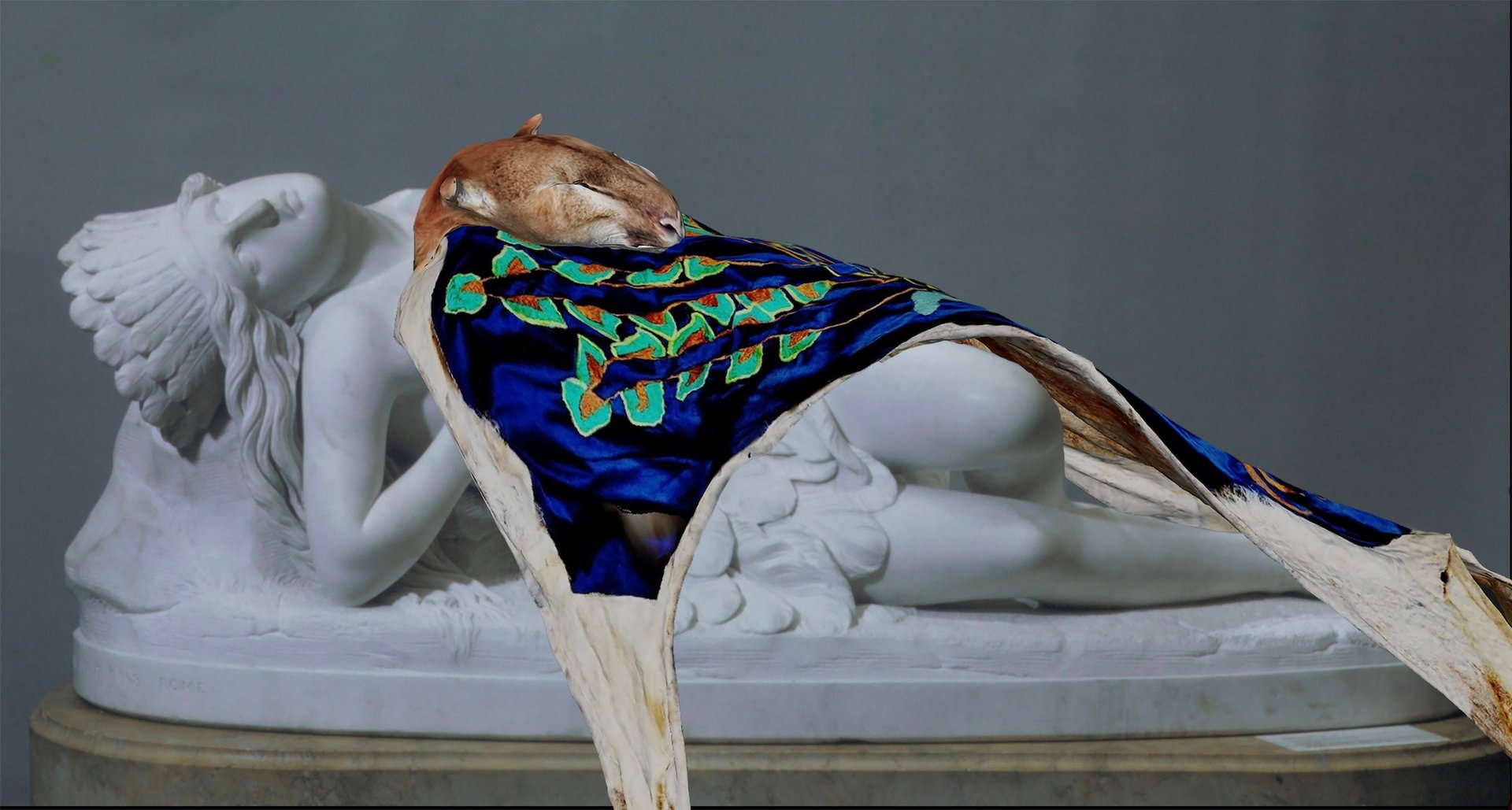
Priscilla Dobler Dzul’s Future Cosmologies: The Regeneration of Maya Mythologies (2023) digitally overlaid on Thomas Crawford’s Mexican Lady Dying (1846, carved 1848) on the Metropolitan Museum of Artwork Courtesy the artist and Amplifier
Not all of the members in ENCODED see the Met as an adversary. The Seneca-Cayuga artist Amelia Winger-Bearskin, who makes use of synthetic intelligence (AI) as a artistic medium, describes a extra nuanced relationship to the establishment.
“I’ve an attractive relationship with the Met rising up in New York—my son took lessons there. I had a pal who led an artwork and tech incubator contained in the Met after they had a grant to take a look at rising applied sciences,” Winger-Bearskin says. “The Met has at all times taught me easy methods to work together with it. I feel it’s arrange for all these interactions—constructing this AR layer on prime of it to increase these conversations.”
The interventions themselves are each playful and pointed. Guests can use a hyperlink for a self-guided tour on their telephones, activating these digital transformations as they traverse the American wing and the Met’s exterior by holding up their telephones earlier than chosen works. For his contribution, the Shinnecock photographer Jeremy Dennis transposed the White Home on prime of a portray of the Parthenon, exhibiting the identical disregard for Western sacred websites that has been proven to Native ones––such because the defacing of the Black Hills to create Mount Rushmore. Priscilla Dobler Dzul digitally enrobed Thomas Crawford’s sculpture Mexican Dying Lady (1846-48) in a florally embellished funerary massive cat pores and skin, head and all.
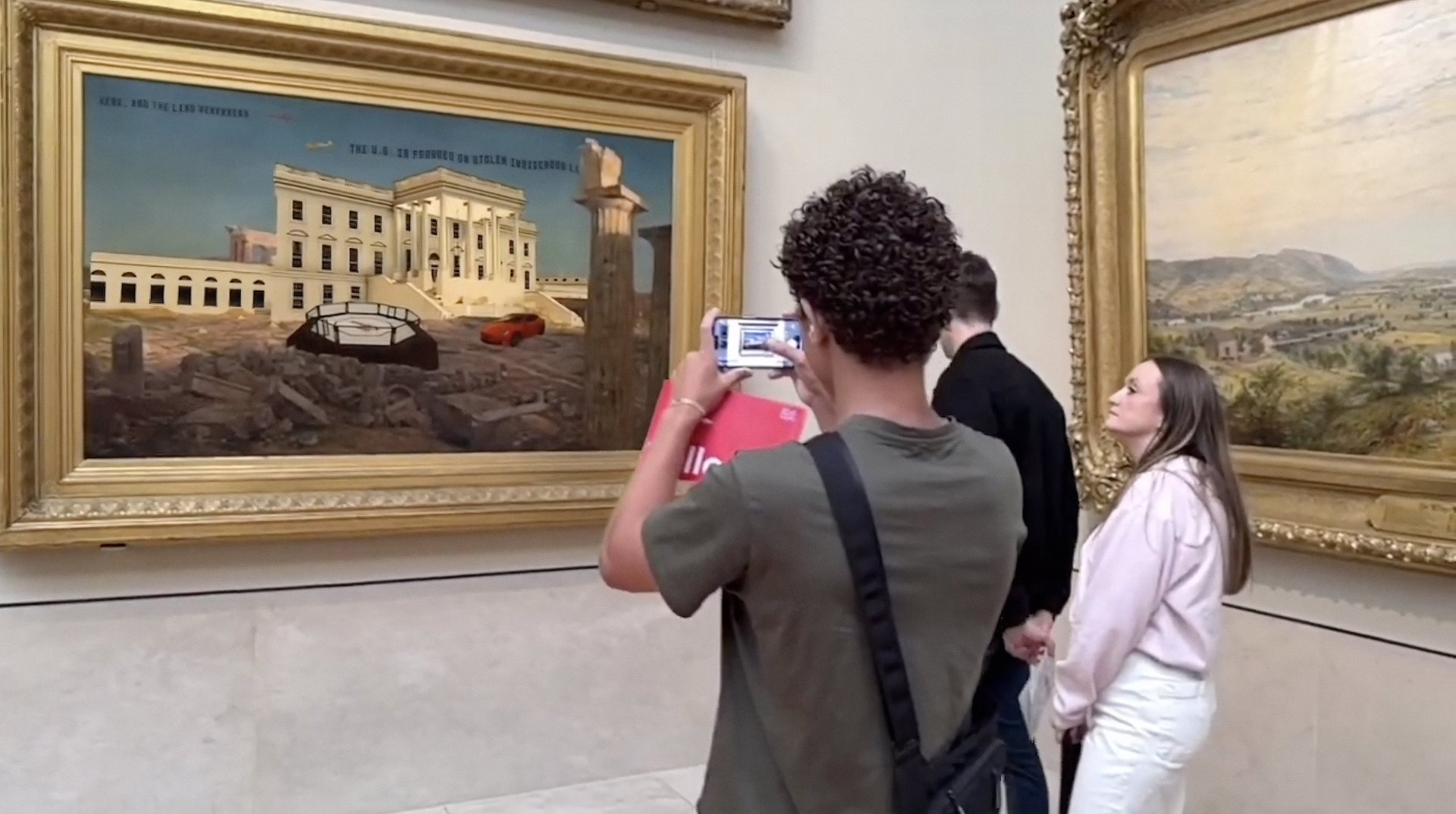
Jeremy Dennis’s The White Home (2025) digitally overlaid on Frederic Edwin Church’s The Parthenon (1871) on the Metropolitan Museum of Artwork Courtesy the artist and Amplifier
Some artists’ jocose transformations work by means of wordplay, like Mer Younger transposing a well-known {photograph} of We’wha—a Zuni two-spirit artist and religious chief who travelled to Washington, DC in 1886—over Childe Hassam’s Avenue of the Allies, Nice Britain (1918). The unique portray depicts a patriotic show of flags from European and Latin American nations alongside Fifth Avenue in help of US involvement within the First World Struggle. These nations had been no allies to queer Indigenous individuals, and Younger’s intervention affords a pointed play on the modern LGBTQIA2S+ language of allyship.
“I needed to ensure the artists might signify themselves as they needed,” Rector says. “A by means of line was cosmology: not solely responding to American masters, however alternatives to indicate methods of resistance and never simply reframing however creating new narratives.”
In reference to the undertaking’s unsanctioned natured, Document provides: “About 5 years in the past the Met labored with plenty of placards that supplied a Native perspective on items of artwork. These are now not up. I’d love establishments, particularly the Met, to deliver again that counter-balance. As we all know historical past is usually instructed by the winners, or these in energy.”