Leveraged tokens and perpetual futures characterize two distinct approaches to reaching leveraged publicity. On the coronary heart of leveraged tokens’ distinctive habits lies their rebalancing mechanism, designed to take care of leverage inside a focused vary. This contrasts with perpetual futures, the place the leverage issue fluctuates in tandem with the value actions of the underlying asset.
However past the mechanics, how do these devices fare in the actual world? Which situations favor the efficiency of 1 over the opposite? And importantly, how can one use this data to pick essentially the most acceptable instrument for his or her wants?
This text delves into these questions by inspecting varied historic worth situations and immediately evaluating the outcomes. The aim is to light up the nuances of every choice, serving to customers to make knowledgeable choices within the evolving panorama of leveraged DeFi merchandise.
Situation one: Trending markets
Trending markets, characterised by clear and constant upward or downward worth actions, present a wonderful instance of the distinct habits between leveraged tokens and perpetual futures. Current cases of such developments embrace the Solana rally, the place its worth surged from $20 to $200, and the Bitcoin rally, with its worth rising from $27,000 to $73,000, each of which unfolded between October 2023 and March 2024.
In Determine 1, the efficiency comparability between the leveraged token (pink line) and the perpetual future (gray line) demonstrates a transparent benefit for the leveraged token. The underlying mechanism liable for this outperformance is the rebalancing course of, marked by blue vertical traces. Rebalancing routinely adjusts the place’s notional worth – primarily the full dimension of the leveraged publicity – every time the leverage issue hits a selected threshold. This adjustment results in elevated publicity, which in flip amplifies returns as the value continues to rise.
On this specific instance, the perpetual future’s leverage issue had decreased from 2x to 1.06x with a notional of $18,399 by March 18th. The leveraged token’s leverage issue, alternatively, remained round 2.02x with a notional of $96,144, showcasing the potential advantages of leveraged tokens underneath these market circumstances.
Situation two: Worth actions that set off liquidations
In distinction to the habits of leveraged tokens in state of affairs one, their efficiency throughout antagonistic worth actions reveals a distinct benefit. In such situations, the rebalancing mechanism decreases the notional worth, resulting in decreased leveraged publicity. This considerably mitigates the danger of liquidation by lowering publicity throughout downturns.
Perpetual futures, nevertheless, don’t share this rebalancing characteristic. They exhibit a fluctuating leverage issue till the market reaches a liquidation worth.
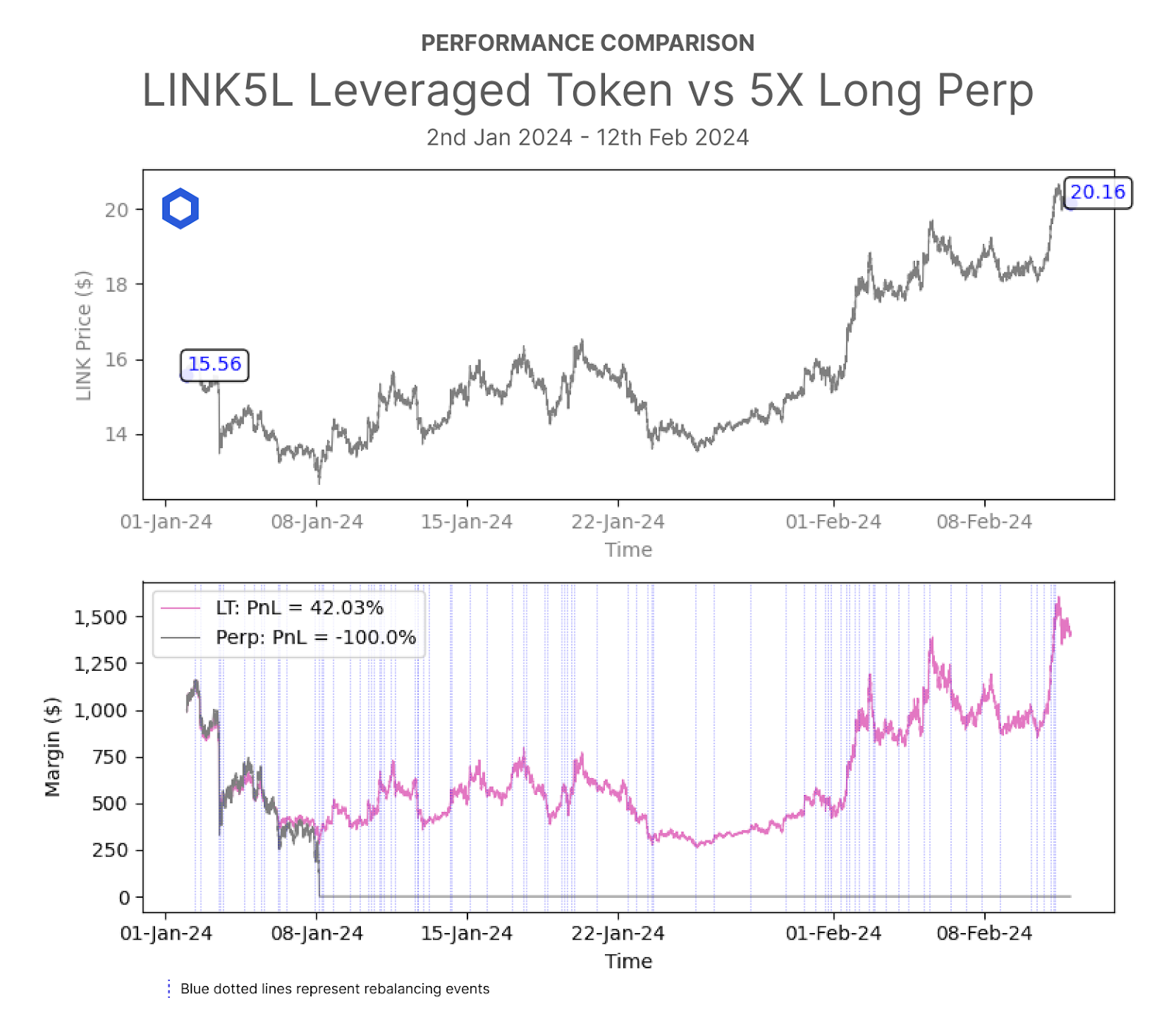
Determine 2 illustrates such a state of affairs. The lower of the $LINK worth throughout the first week of January 2024 led to the liquidation of the perpetual future shortly after the place was opened.
In distinction, the leveraged token, though experiencing a margin lower much like that of the perpetual future, underwent a number of rebalancings all through the downturn. These rebalancing actions successfully decreased the quantity of borrowed funds, thereby lowering leveraged publicity and stopping liquidation. This mechanism allowed the leveraged token to take care of its place all through the interval of declining costs, showcasing the danger administration capabilities inherent within the construction of leveraged tokens.
Situation three: Flat and risky worth actions
The primary two situations supplied insights into market circumstances the place leveraged tokens are inclined to outperform perpetual futures. Nonetheless, rebalancing additionally introduces a possible draw back in sure market environments. Particularly, in markets characterised by flat or risky worth actions, the place the necessity for frequent rebalancing – each uplevering and downlevering – can lead to what is named volatility decay. The mathematical basis underlying this course of is defined within the official Synthetix Documentation underneath the part “Volatility decay”.
Perpetual futures don’t face this difficulty and normally outperform leveraged tokens underneath these market circumstances, given they don’t get liquidated.
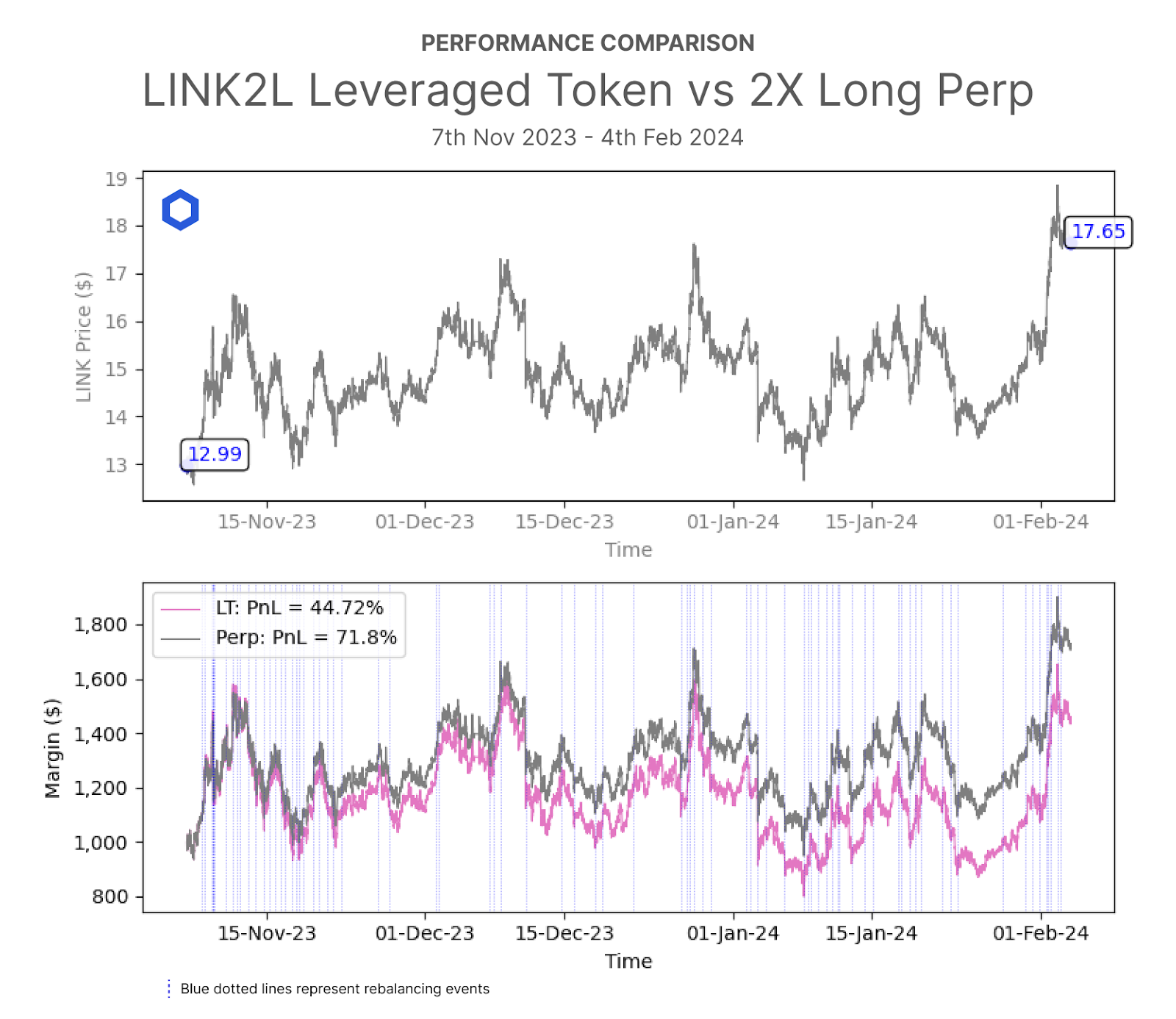
Determine 3 depicts a state of affairs of steady sideways motion and excessive volatility within the $LINK worth. It clearly demonstrates the depreciating margin of the leveraged token over time, resulting in underperformance in comparison with the perpetual futures contract. The influence of volatility decay on the leveraged token can be additional intensified by increased leverage components, highlighting the challenges leveraged tokens face in risky, directionless markets.
Situation 4: Steady antagonistic worth growth
In situations with steady antagonistic worth motion, rebalancing can mitigate however not stop the influence on the margin. Ought to the value of an underlying asset persistently transfer towards a place, the margin of a leveraged token will inevitably decay over time. This highlights the limitation of rebalancing in safeguarding a place towards extended unfavorable market developments.
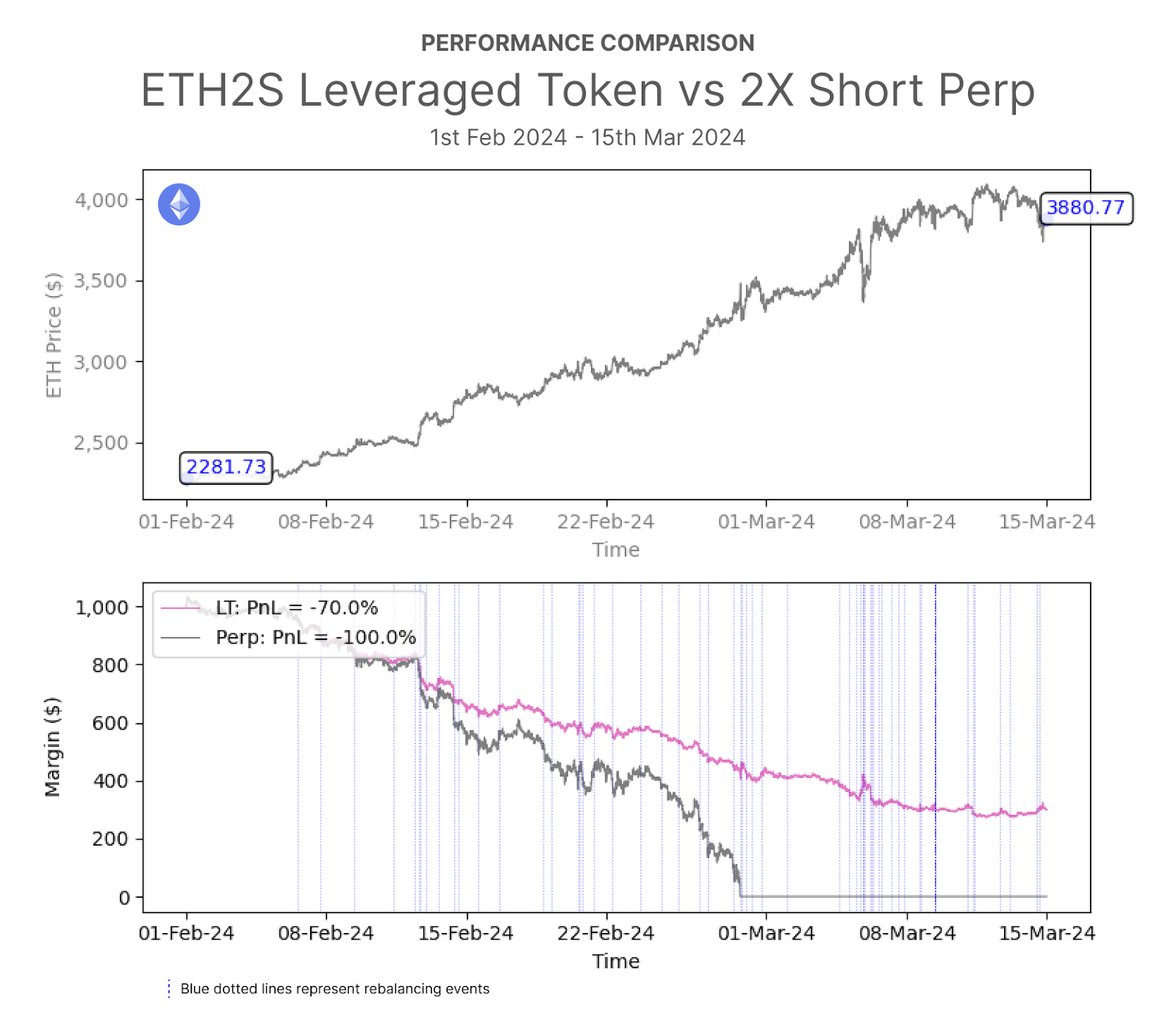
Determine 4 showcases the dynamics of a brief place throughout the worth appreciation of $ETH from February to mid-March 2024. The perpetual future confronted liquidation at the start of March. In distinction, by March fifteenth, the leveraged token had nonetheless preserved 30% of its margin. Nonetheless, ought to this upward pattern proceed, the margin of the leveraged token would decay nearly solely, illustrating the gradual influence of antagonistic worth actions on leveraged token positions.
Conclusion
Leveraged tokens and perpetual futures every shine underneath totally different market circumstances. Leveraged tokens outperform in trending markets because of their rebalancing mechanism and supply safety towards liquidation in antagonistic actions. Nonetheless, this identical characteristic results in volatility decay in flat or risky markets, the place perpetual futures are inclined to excel, assuming they keep away from liquidation. Whereas leveraged tokens can mitigate losses in downturns, extended antagonistic developments can nonetheless erode their margin. Customers should take into account these dynamics, balancing the potential for amplified returns towards the dangers of volatility decay and market actions, to decide on the precise instrument for his or her technique.
Disclaimer
This text is for informational functions solely and isn’t meant as monetary or funding recommendation. All content material displays the writer’s views and shouldn’t be seen as particular funding suggestions. Traders ought to do their very own due diligence or seek the advice of an expert advisor earlier than making funding choices. The writer bears no duty for any monetary losses ensuing from funding selections based mostly on this text.
The mannequin used for producing the charts excludes funding charges and charges for each leveraged tokens and perpetual futures. This exclusion should not notably have an effect on the efficiency comparability.