
A sprawling up to date avenue mural, a residing memorial to girls murdered in Italy since 2012, might be restored tomorrow, Worldwide Girls’s Day (8 March), by neighborhood members in Rome’s San Lorenzo district. Murale contro il Femminicidio (Mural In opposition to Femicide, 2012-13), by the Italian artistsMarina Biagini and Elisa Caracciolo, marks the deaths of a whole lot of ladies by the hands of males, by home or different violence.
The mural is atypical of Rome’s graffiti writing the place, on residential buildings and industrial edifices, tags are frantically “thrown up” over imagery on painted scenes. As a substitute, on the website of this work created with home paint, graffiti halts abruptly on the mural’s starting, and recommences in intense commotion at its finish. It’s a outstanding fracture, a screeching optical pause within the mores of avenue artwork, an indication of seriousness and neighborhood reckoning.
Mural In opposition to Femicide is realised on two perpendicular partitions the place By way of dei Sardi and By way of degli Enotri meet, surrounding taking part in fields and a 1926 constructing. The artist-activist pair, identified collectively as WaW Duo, chosen the location particularly for this venture. They had been moved to create the mural right here by a combination ofoutrage at patriarchal violence in Italy, the teeming avenue nook’s proximity to scholar and college communities of Sapienza College, and the realm’s long-term acceptance of public murals and left-leaning political historical past.
Marina Biagini and Elisa Caracciolo, Murale contro il Femminicidio (Mural In opposition to Femicide), 2012-13 Photograph: Francesco Campanini
“We had been on the lookout for a option to characterize the unimaginable variety of girls who had been killed,” Biagini says, “the variety of lives which can be damaged. When you find yourself in entrance of the wall, you’ll be able to see how [big] the issue is.” The mural commemorates the murders of 128 girls in 2012 and 130 in 2013. In response to the Italian Ministry of the Inside’s report on gender violence, between January and December 2024, 101 girls had been killed, greater than half by their companion or ex-partner. (It’s unclear if the info contains data on homosexual or trans girls.)
Caracciolo provides that the dimensions of the assaults contributed to siting: “We regarded for a wall that was massive and lengthy sufficient. And we wished to decide on a spot already open to this sort of inventive expression. San Lorenzo had each.”
San Lorenzo’s historical past doesn’t derive from larger-than-life Roman emperors. The power of the neighborhood is rooted in its historical past as a employees’ settlement, with seen proof of damage from a 1943 Allied bombing marketing campaign and of resistance fighters inside, with the added vibrancy from the college and plentiful out of doors artwork with probing political themes. The neighbourhood has welcomed daring foment on its streets, from artists and graffiti writers, and is extra well-known for scholar hangouts and nightlife than for tourism.
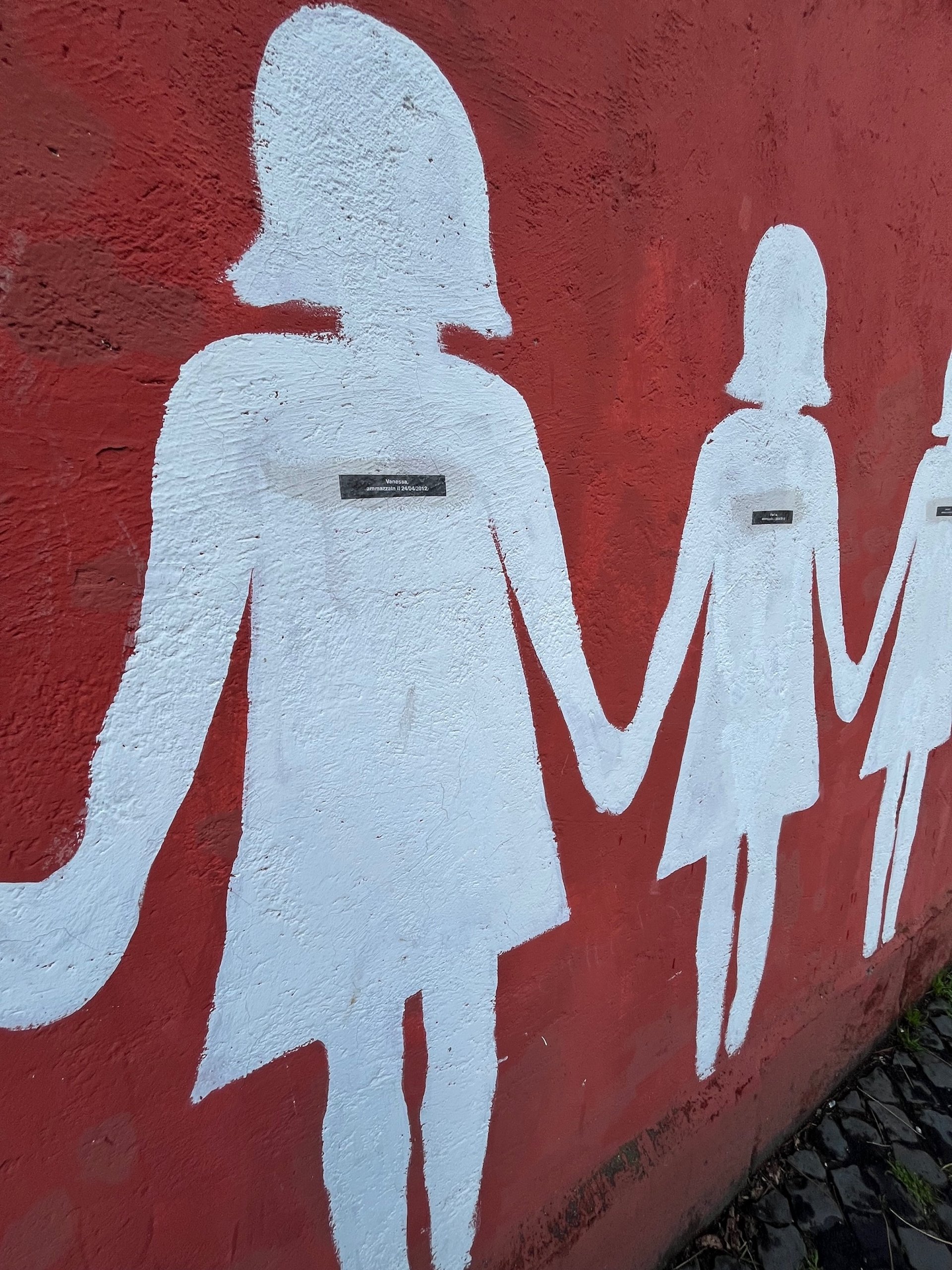
Marina Biagini and Elisa Caracciolo, Murale contro il Femminicidio (Mural In opposition to Femicide), 2012-13 (element) Photograph: Brooke Kamin Rapaport
In Biagini and Caracciolo’s mural, the white silhouettes of greater than 2 hundred girls are painted on a terracotta-hued background. Their outlines are a recurring template whose linear simplicity evokes a easy paper doll chain, interconnected by handholding. When viewers face the figures within the mural, they could consider the delicate folds and repetition of cutout playthings, however the relationships are as an alternative by a sequence of violence the place figures beckon passersby at human scale. Their individuality is assured: every lady, ranging in age from their teenagers to their seventies, bears a primary title and the date of her homicide written in a small darkish rectangle positioned on her higher chest.
For the reason that mural was accomplished, members of the family have written to Biagini and Caracciolo requesting photographs of the picture of family members. The names had been initially culled from sources gathered by Bologna’s Girls’s Home to Not Endure Violence. As we speak, data on girls’s deaths in Italy is accessible throughout governmental portals and different web sites.
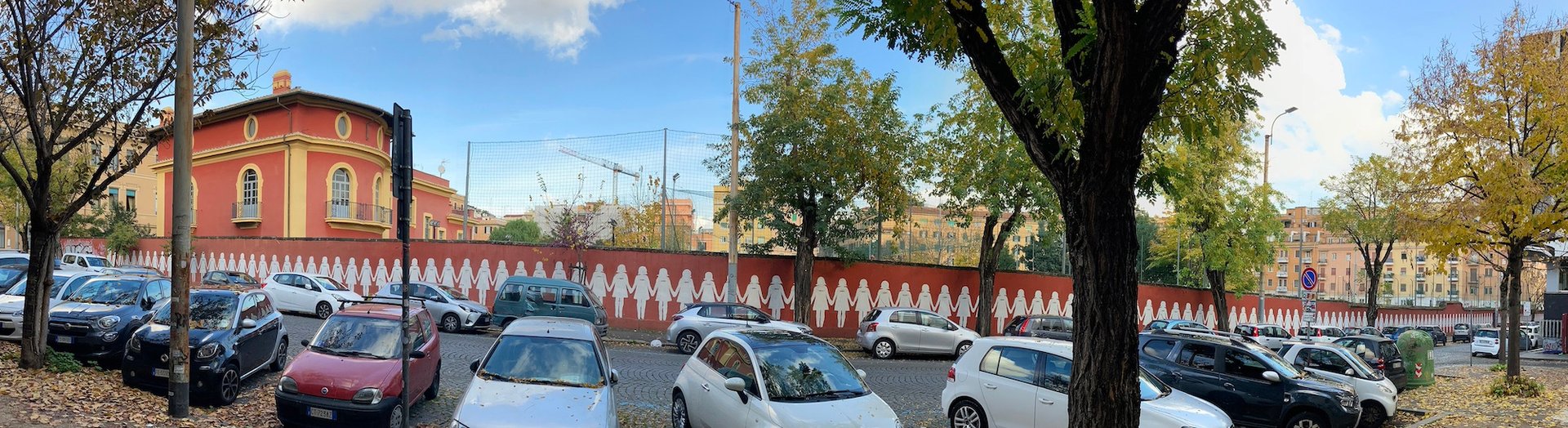
Marina Biagini and Elisa Caracciolo, Murale contro il Femminicidio (Mural In opposition to Femicide), 2012-13 Photograph: Francesco Campanini
The choice to incorporate first names to mark the brutal lack of particular lives provides humanity to the venture, at the same time as a shared inhumanity unifies the imagery. This apply parallels the “Say Their Names” marketing campaign of the worldwide Black Lives Matter motion in 2014, the place the deceased particular person is heralded somewhat than generalised. After Trayvon Martin was murdered in Florida in 2012, consciousness of the crime got here from the continuing recitation of his title. Since then, names of victims are chanted privately and publicly, in houses, on streets, in parks, on campuses and at civic centres.
Although graffiti writers have largely revered the boundaries of Mural In opposition to Femicide, the work has nonetheless been vandalised, with some names gouged out—an assault on id. Biagini, Caracciolo, residents and different teams have restored the names and at this time and tomorrow they are going to clear the partitions earlier than becoming a member of the hundreds anticipated to march in Rome on Worldwide Girls’s Day. As a result of the partitions will accommodate no extra figures and because the artists survey new potential websites, the venture continues on social media, up to date with data of latest victims. On this means, the mural has entered the digital commons, a shared house the place its attain is limitless.