Ripple and XRP had been thrust into the highlight after SWIFT chief innovation officer (CIO) Tom Zschach delivered a pointed critique on LinkedIn—extensively learn as a jab on the firm and its XRP token—over what truly constitutes “resilience” for banks and the way institutional belief is earned.
The alternate started beneath a remark praising Ripple’s regulatory endurance, the place Zschach countered bluntly: “Surviving lawsuits isn’t resilience. Impartial, shared governance is. Establishments don’t need to reside on a competitor’s rails.” He adopted by rejecting the notion {that a} single agency’s rapport with watchdogs equals compliance, writing: “And compliance isn’t about one firm convincing regulators it ought to be allowed to function. It’s about a whole business agreeing on shared requirements that no single stability sheet controls.”
Ripple Vs. SWIFT
Zschach then broadened the body in an extended publish about how banks truly undertake expertise. “Each main shift in finance begins the identical approach. Know-how lays the inspiration however belief decides when the constructing opens.”
He recalled that earlier “subsequent massive issues” in finance stalled not on throughput, however on the absence of compliance and safety. The parallel he drew to public blockchains in 2025 was specific: they’re changing into too consequential to disregard—“Tokenized treasuries. Collateral on-chain. Cross-border funds that truly settle”—but uncooked technical efficiency shouldn’t be the end line.
They assume the general public chain itself is the answer. It isn’t,” he argued, calling public networks “the bottom atmosphere for execution,” highly effective for deterministic, programmable settlement however inadequate with out the “belief layer” of authorized enforceability, compliance, and privateness. With out that layer, he warned, a public chain is “a quick engine with no cockpit.”
Crucially, Zschach’s critique drew a governance boundary that cuts to the center of Ripple’s pitch to banks with out naming the corporate. He re-centered the dialog on neutrality and shared management, moderately than on the courtroom sturdiness or regulatory narratives of any single agency. In his phrases, establishments need “shared requirements that no single stability sheet controls,” and they’ll resist relying on “a competitor’s rails.”
He prolonged the warning to consortia as properly: “If a financial institution joins a sequence owned or managed by one other financial institution then they’re accepting another person’s governance, incentives and guidelines of the sport. In in the present day’s atmosphere is {that a} type of dependency that banks will probably be comfy with?” The throughline is that institutional adoption hinges much less on whether or not one vendor has outlasted enforcement actions and extra on whether or not the infrastructure is credibly impartial, co-governed, and enforceable in regulation.
Zschach’s taxonomy of public chains as “substrate” underscores how he expects the business to evolve. In biology, computing, and building, a substrate is foundational; what issues for banks is what will get layered above it. He urged builders to not “battle the general public chains” however to harness them whereas fixing for compliance from day one and for privateness “with out killing transparency.”
That’s the place he believes the “alternative lies,” with finance in the end “absorbing the very best of public chains by itself phrases.” The open query he posed again to the market—“When will banks and monetary establishments really belief public blockchains and at what tempo will that belief construct?”—places the burden of proof on governance design and requirements alignment, not on advertising milestones.
For Ripple and XRP, the implication is obvious even when Zschach by no means typed the identify in his critique: the bar for financial institution adoption isn’t surviving litigation or securing inexperienced lights for a particular product stack; it’s convincing the business that the rails they experience are impartial, shared, and never managed by any single firm’s stability sheet (like Ripple’s escrow nonetheless controlling greater than 35% of all XRP). In that lens, resilience is measured in how energy is distributed, how guidelines are enforced, and the way privateness and compliance are engineered—exactly the size Zschach says resolve “when the constructing opens.”
At press time, XRP traded at $2.77.
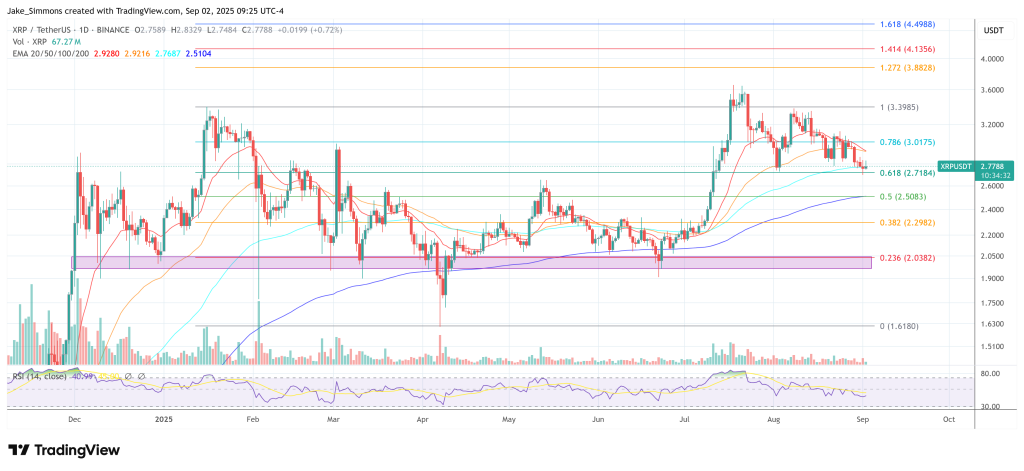
Featured picture created with DALL.E, chart from TradingView.com

Editorial Course of for bitcoinist is centered on delivering totally researched, correct, and unbiased content material. We uphold strict sourcing requirements, and every web page undergoes diligent evaluate by our crew of prime expertise consultants and seasoned editors. This course of ensures the integrity, relevance, and worth of our content material for our readers.