Ethereum co-founder Vitalik Buterin framed the community’s subsequent scaling step as each audacious and tightly risk-controlled, saying “Fusaka will repair this” whereas underscoring that “security first is of the utmost significance.” In an in depth put up, Buterin described Fusaka’s core characteristic—PeerDAS—as “attempting to do one thing fairly unprecedented: have a reside blockchain that doesn’t require any single node to obtain the complete knowledge.”
He added that PeerDAS depends on probabilistic sampling of knowledge “chunks,” and, if greater than half of these chunks can be found, nodes can retrieve them and reconstruct the rest through erasure coding. “That is all new know-how, and the core devs are smart to be tremendous cautious on testing,” Buterin wrote, noting that blob provide will ramp “conservatively at first,” then extra aggressively if situations allow.
Buterin Calls Fusaka the Key To Ethereum L2 Scaling
Buterin’s remarks arrive simply as Ethereum’s new blob market reveals indicators of pressure. Head of Knowledge at Dragonfly Hildebert Moulié reported that the chain “hit 6 blobs/block for the primary time,” attributing the current surge primarily to rollups and initiatives together with Base and Worldcoin. Based on the identical thread, Base submitted roughly 35% of blobs and used about 42% of blobspace, with Worldcoin contributing round 20% of submissions and 25% of utilization; Arbitrum, OP Mainnet, Soneium, Scroll and others comprised many of the the rest.
The analyst added that L2s now account for about $200,000 per week in mainnet charges for submissions, validators require greater than 70 GB of storage for blobs (over 1.2 TB if unpruned), and that many blobs aren’t totally utilized—notably on smaller rollups posting extra ceaselessly than they will fill 128 KB payloads. The primary sustained base-fee spike because the Pectra laborious fork was additionally noticed, though hildobby cautioned that “blob worth discovery” nonetheless requires a extra extended saturation of demand.
PeerDAS is the architectural response. Buterin defined that every node requests solely a small variety of chunks to confirm that over half of the info is out there; in that case, the node “theoretically can obtain these chunks, and use erasure coding to get better the remainder.”
In its preliminary incarnation, two non-custodial roles nonetheless require full-block knowledge to exist someplace on the community—preliminary broadcast and emergency reconstruction when a writer reveals solely a fraction of a block—although “we solely want one sincere actor” for these duties, and future “cell-level messaging and distributed block constructing will enable even these two features to be distributed.” The endgame, he steered, is to unlock sustained L2 scaling and, as L1 block gasoline limits rise, to finally route extra L1 execution knowledge into blobs as properly.
This pivot lands amid a quickly evolving blob market. After Pectra, Ethereum elevated the blob goal and most per block, increasing every day knowledge capability and paving the way in which for larger throughput from rollups; analysis desks have linked that shift to a fancy interplay between L1 base charges, blob charges, and L2 submission habits.
The Fusaka timetable provides urgency. Core builders have signaled a mainnet activation for December 3, 2025, following staged testnet rollouts, putting Buterin’s “security first” emphasis in clear aid. PeerDAS will debut beneath strict limits, with blob counts elevated “conservatively at first,” a posture designed to keep away from payment whiplash and to look at how various L2s really eat the added capability.
Exterior the protocol notes, empirical work is accumulating round how networks would possibly use blobspace extra effectively. A 2024 examine on “blob sharing” argued that smaller rollups ceaselessly under-fill blobs and will reduce posting prices by greater than 85% by cooperatively packing knowledge into shared blobs, smoothing the bottom payment and reducing the whole variety of blobs submitted.
Ethereum researchers have since expanded that argument, modeling how sharing reduces blocks with greater than the goal variety of blobs and thereby dampens the exponential blob-fee changes that kick in when utilization overshoots targets. These findings dovetail with Moulié’s remark that “many blobs aren’t full,” implying giant financial savings can be found by means of higher coordination because the market matures.
The conceptual roots of PeerDAS stretch again by means of Ethereum analysis notes on data-availability sampling and Buterin’s personal writings on “The Surge.” PeerDAS itself implements one-dimensional sampling with erasure coding and succinct per-cell proofs, enabling nodes to validate availability with out naively downloading all the pieces. That’s what makes the method “fairly unprecedented” in a reside, high-value blockchain: it seeks to reconcile decentralization and throughput by lowering per-node bandwidth and storage necessities whereas preserving robust ensures that knowledge really exists.
Nonetheless, the shift will not be with out dangers. Buterin’s insistence on a cautious rollout displays the fact that Ethereum’s blob financial system is younger, risky, and delicate to sudden modifications in demand. As L2s jostle for capability, payment dynamics can invert shortly, and incomplete blobs, spiky utilization, and MEV unintended effects complicate forecasting. The promise of Fusaka is that PeerDAS can bend these dynamics towards sustainable progress by letting the community scale knowledge availability with out forcing any single node to shoulder the entire chain—and by doing so in a manner that retains safety assumptions specific and testable.
At press time, ETH traded at $4,028.
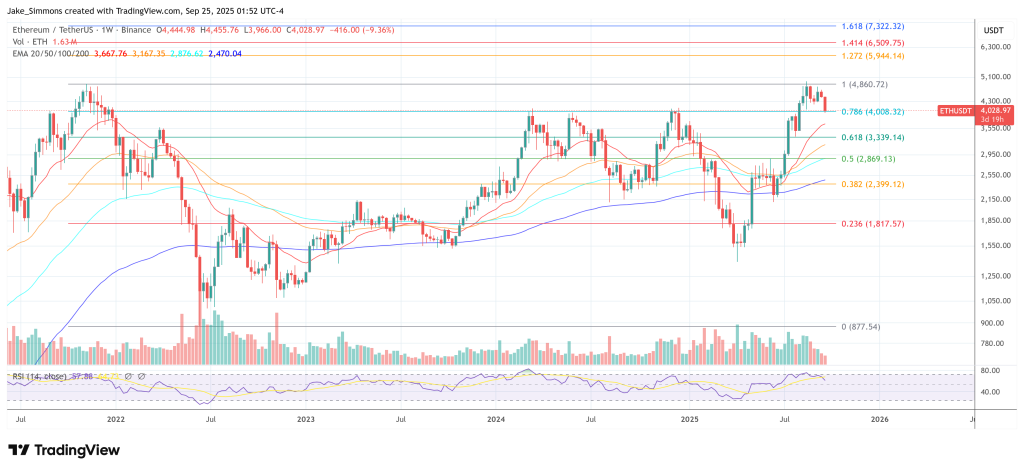
Featured picture created with DALL.E, chart from TradingView.com

Editorial Course of for bitcoinist is centered on delivering totally researched, correct, and unbiased content material. We uphold strict sourcing requirements, and every web page undergoes diligent assessment by our group of prime know-how consultants and seasoned editors. This course of ensures the integrity, relevance, and worth of our content material for our readers.