
The European Central Financial institution (ECB) has quietly given the XRP Ledger a spot in its wholesale-DLT sandbox—but solely behind the partitions of a closed community. Annex II of the ECB’s June 2025 report describes 48 trials and experiments, however a single venture run by Lithuanian fintech Axiology is the one one grounded in its know-how.
XRP Ledger Powers ECB Trial
Axiology’s DLT Buying and selling and Settlement System (TSS) is, within the ECB’s personal phrases, a “non-public, permissioned infrastructure constructed utilizing the open-source code of the XRP Ledger.” The central financial institution instantly qualifies that pedigree: “Whereas Axiology advantages from XRP Ledger know-how, it operates as an impartial system, designed to streamline buying and selling, settlement, and custody of tokenized belongings.” Briefly, the code is XRPL-inspired, however the sandbox itself is hermetically sealed.
The trial rehearsed three occasions—major issuance, coupon funds, and maturity redemption—whereas the Banque de France’s Set off Answer dealt with central-bank cash. Within the issuance section the ledger recorded that “Node sends asset quantity from issuer’s operational pockets to created escrow pockets, which makes use of XRP Cost transaction,” after which “Operator transfers quantity of asset from escrow pockets to ultimate investor’s pockets, utilizing XRP Cost transaction and thus finalizing DVP.”
Later, throughout redemption, the report exhibits the circulation reversing: “Node sends quantity of asset from end-investor pockets to created escrow pockets, which makes use of XRP Cost transaction,” and at last “Operator transfers quantity of asset from escrow pockets to Issuer Agent Operational Pockets utilizing XRP Cost transaction, thereby finalising DVP and initiating burning course of.”
These six sentences—the 2 structural descriptions plus 4 transaction steps—are the doc’s total reference set to “XRP.” Nowhere does the annex recommend that the token, open-network validators, or public liquidity swimming pools had been concerned; each switch ran strictly inside a permissioned ledger, and the money facet remained pure central-bank cash.
Axiology says its objective was to check the “efficiency and reliability” of synchronizing delivery-versus-payment in central-bank euros with a tokenized bond ledger. For the ECB, the train is one in all many in a comparative sweep that already contains Canton, Corda, and Ethereum variants. The findings will inform no matter wholesale CBDC structure the Eurosystem could someday pursue.
The upshot is stark: the ECB did trial Ripple’s know-how, however solely in a sealed setting, indifferent from the general public ecosystem. For proponents it’s a technical validation; for skeptics it exhibits regulators are nonetheless cautious of open networks. Both method, the catch stays: the know-how was allowed contained in the room, but the door to public adoption stays seemingly firmly shut.
At press time, XRP traded at $2.18, up 13% because the Sunday low at $1.90.
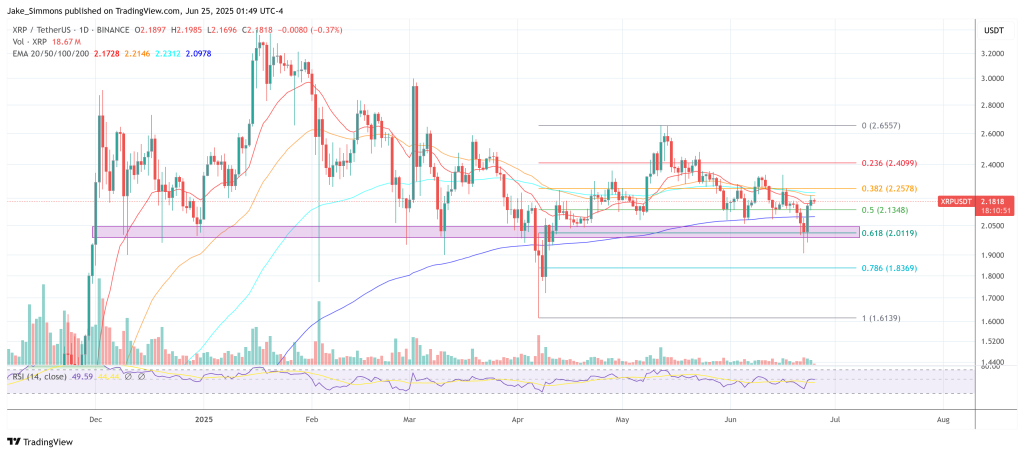
Featured picture created with DALL.E, chart from TradingView.com

Editorial Course of for bitcoinist is centered on delivering totally researched, correct, and unbiased content material. We uphold strict sourcing requirements, and every web page undergoes diligent evaluate by our staff of prime know-how consultants and seasoned editors. This course of ensures the integrity, relevance, and worth of our content material for our readers.