
With over 560 million customers globally, cryptocurrency has captured vital consideration. But, this spectacular quantity represents lower than 5% of the world’s inhabitants, highlighting its comparatively area of interest standing. Nonetheless, if you happen to ask any actual crypto fanatic, they may inform you that they stay up for the day when crypto replaces money/fiat as we all know it at this time.
Saifedean Ammous, writer of The Bitcoin Commonplace, described Bitcoin because the pure subsequent step within the evolution of finance.
However will crypto ever break away from its area of interest standing to turn out to be part of on a regular basis life, or is it destined to stay the playground of tech fanatics, high-risk traders, and DeFi hobbyists?
Exploring this query is critical due to the basic promise underpinning the know-how powering it. There should be very clear steps outlined for shifting crypto from its present state into the on a regular basis lives of billions so the benefit of the argument and promise will be certainly seen and accepted.
The Present Panorama: Glimpses of a Crypto Revolution
To grasp the place cryptocurrency stands at this time, it helps to borrow from Nasdaq’s adoption curve concept, which suggests that know-how grows slowly till it reaches a tipping level (8–10% adoption), after which it experiences fast mass adoption.
Cryptocurrencies could also be approaching this inflection level. There are already hints of a crypto revolution. In accordance with the “International Crypto Adoption Index” by Chainalysis, between late 2023 and early 2024, international crypto exercise surged past the degrees of the 2021 bull market.
Company and Institutional Adoption
Company buy-in has been a major catalyst for cryptocurrency’s development. Corporations like MicroStrategy, Metaplanet, Semler Scientific, and Genuis Group maintain Bitcoin of their reserves. Many others have introduced plans to observe swimsuit, signaling confidence in digital property as a retailer of worth. Equally, institutional curiosity is rising. A 2023 Nomura investor survey revealed that allocators count on to take a position 5–10% of their portfolios in digital property inside three years.
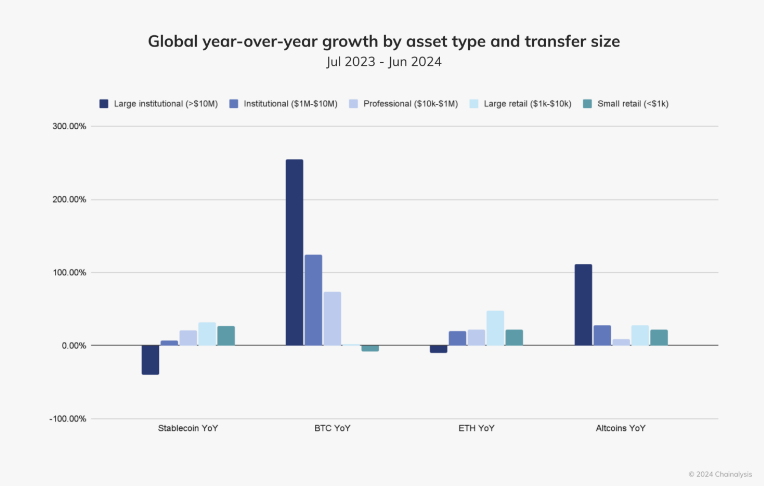
The approval of Bitcoin ETFs within the U.S. has additional legitimized crypto, paving the best way for broader adoption in conventional monetary markets, notably by way of institutional-sized transfers in North America and Western Europe.
Shifting Authorities and Political Dynamics
Governments are additionally experimenting with cryptocurrencies, albeit cautiously. El Salvador made headlines when it adopted Bitcoin as a authorized tender. Whereas most do not make such a daring alternative, many are already contemplating including cryptocurrency to their nationwide asset reserves, identical to company entities. There are stories of proposals from main stakeholders worldwide, from the large gamers within the international economic system like Germany, Russia, the European Union, and the US to the comparatively small gamers just like the Czech Republic and Poland.
Additionally, the current wave of tax legal guidelines aimed toward cryptocurrency signifies that these governments are lastly recognizing the legitimacy of this monetary asset.
RELATED: Are Crypto Taxes a Sustainable Supply of Authorities Income?
Instruments for On a regular basis Use
Mainstream monetary instruments and platforms are integrating crypto, making it extra accessible for on a regular basis use. PayPal’s crypto options and stablecoins’ utility for remittances in areas like Sub-Saharan Africa and Latin America reveal crypto’s sensible purposes.
Stablecoins, particularly, have confirmed to be a lifeline for underserved populations, enabling reasonably priced transactions and monetary inclusion. Residents of lower-middle-income nations are additionally driving adoption, utilizing them for remittances and as a substitute for conventional banking techniques. For instance, the launch of stablecoin-backed cost networks in locations like Kenya has considerably lowered the price of cross-border remittances, a key use case for crypto.
Excessive-income nations are additionally seeing adoption, albeit at a slower tempo. Institutional-sized transfers have grown in areas like North America and Western Europe, spurred by occasions just like the launch of Bitcoin ETFs. Nonetheless, adoption in these areas is extra tied to speculative investments and portfolio diversification than sensible use circumstances.
Crypto debit playing cards and crypto ATMs are different attention-grabbing methods which can be being explored with measured success to reveal crypto’s utility for day by day transactions.
READ MORE: Crypto ATMs: Have they been Efficient as Promised?
Challenges to Mass Adoption
Regardless of these strides, cryptocurrency’s journey to mass adoption faces vital boundaries. These challenges have to be addressed to unlock crypto’s full potential.
Regulatory Uncertainty
An absence of constant and globally coordinated laws creates confusion for customers and traders. Unclear classifications—whether or not crypto is a safety, utility token, or forex—additional complicate adoption. Regulatory readability is crucial to constructing belief and guaranteeing mass adoption.
Usability and Complexity
Crypto stays intimidating for the common person. Managing non-public keys, understanding pockets addresses, and navigating complicated KYC/AML processes create a steep studying curve. Till user-friendly options turn out to be widespread, crypto dangers alienating mainstream customers.
For example, platforms like Coinbase and Gemini have labored to make crypto buying and selling extra user-friendly, however many nonetheless battle with understanding pockets administration, safety, and blockchain operations.
Scalability and Transaction Effectivity
Scalability stays a crucial situation. Whereas Visa processes over 24,000 transactions per second (TPS), Bitcoin handles about 7 TPS, and Ethereum manages round 15 TPS. These limitations, coupled with excessive transaction charges, make crypto impractical for day by day use. Layer-2 options just like the Lightning Community provide hope however are usually not but mainstream.
Market Saturation and Interoperability Challenges
The crypto ecosystem is oversaturated with hundreds of tokens, every claiming to resolve distinctive issues. This abundance overwhelms customers, whereas the shortage of interoperability between blockchains undermines crypto’s promise of seamless, borderless transactions.
Initiatives like Polkadot and Cosmos try to resolve the problem of blockchain interoperability, which might play a key position in unifying the crypto ecosystem.
Volatility and Lack of Stability
Cryptocurrency’s infamous value volatility makes it unreliable as a medium of trade. Think about shopping for espresso with Bitcoin, solely to seek out that the value you paid would have been considerably cheaper—or costlier—the subsequent day. Stability is crucial for broader use, particularly for day-to-day transactions.
Scams and Safety Issues
Regardless of blockchain’s inherent safety, the broader crypto ecosystem has been suffering from hacks and scams. Excessive-profile hacks, just like the $305 million breach of DMM Bitcoin in Could 2024, erode public belief. Chainalysis stories a 21% year-over-year enhance in stolen funds in 2024, totalling $2.2 billion.
Between 2021 and 2023, decentralized finance (DeFi) platforms had been notably vulnerable to hacks, persistently rating as the first targets. These assaults usually exploited weaknesses in sensible contracts or platform safety, highlighting the pressing want for stronger safeguards throughout the crypto panorama.
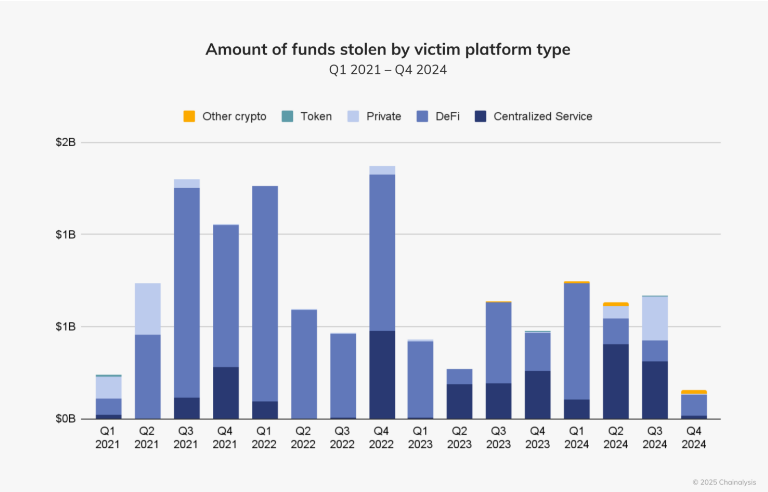
Every breach not solely causes monetary loss but in addition erodes person confidence, reinforcing the notion that the crypto business stays dangerous and unregulated. Till there are clear safeguards and insurance coverage insurance policies in place, potential customers will stay sceptical.
Is Mass Adoption of Cryptocurrency Achievable?
The boundaries are formidable, however they don’t seem to be insurmountable. Advances in know-how, resembling Layer-2 options and blockchain interoperability, can deal with scalability and value challenges. Regulatory readability and training initiatives may also help construct belief and increase the person base.
Moreover, stablecoins and real-world purposes, notably in underserved areas, reveal crypto’s potential as a practical monetary software reasonably than a speculative asset. The mixture of grassroots adoption, institutional participation, and technological innovation means that mass adoption will not be a query of if however when.
The crypto ecosystem is at a pivotal second—one the place continued innovation and collaboration might decide whether or not it turns into the cornerstone of a brand new monetary period or stays a distinct segment market. Whereas the timeline is unsure, the path is obvious: cryptocurrency is on a path towards remodeling how the world transacts, saves, and invests.
Disclaimer: This piece is meant solely for informational functions and shouldn’t be thought of buying and selling or funding recommendation. Nothing herein must be construed as monetary, authorized, or tax recommendation. Buying and selling or investing in cryptocurrencies carries a substantial danger of monetary loss. At all times conduct due diligence.
If you want to learn extra articles like this, go to DeFi Planet and observe us on Twitter, LinkedIn, Fb, Instagram, and CoinMarketCap Neighborhood.
Take management of your crypto portfolio with MARKETS PRO, DeFi Planet’s suite of analytics instruments.”