
When transacting on Ethereum or executing a wise contract, you pay a “gasoline charge.” These charges are denominated in Gwei, which could appear odd since Ether (ETH) is Ethereum’s native foreign money.
Properly, Gwei is ETH, and technically, it’s a denomination of cryptocurrency.
The Ethereum community makes use of a system of items to signify completely different denominations of ETH. This technique permits Ethereum to deal with quite a lot of transaction sizes and complexities, guaranteeing environment friendly administration of gasoline charges and operations. On the base is Wei, the smallest unit, the place one Ether equals 1 quintillion Wei. As we transfer up, we get Gwei midway via the dimensions; it equals 1 billion Wei.
Ethereum Wallets, explorers (like Etherscan), and dApps all quote gasoline costs in Gwei as a result of it has grow to be the usual unit for gasoline charges.
Why Use Gwei?
The brief reply: Gwei is a handy center floor. It balances precision with usability.
Ethereum transactions contain dealing with very small fractions of ETH, which may result in unwieldy decimal locations if expressed in full ETH. Gwei, being 1 billionth of an ETH, offers a readable and exact strategy to deal with gasoline calculations with out extreme decimal locations.
Additionally, gasoline charges fluctuate based mostly on community demand. If charges have been expressed in full ETH, customers must take care of extraordinarily tiny decimal values. As an alternative, utilizing Gwei simplifies the method—it’s simpler to match “30 Gwei” vs “50 Gwei” than “0.000000030 ETH” vs “0.000000050 ETH.”
There is no such thing as a documented historical past as to when “gwei” turned the usual unit for paying gasoline charges on Ethereum. In truth, the Ethereum Whitepaper didn’t make a single point out of the time period “gwei”
How Are Fuel Charges Calculated?
Since Ethereum’s London Improve (August 2021), gasoline charges encompass:
Fuel Restrict – Most gasoline a person is keen to spend (e.g., 21,000 items for a fundamental transaction).
Base Payment – A required quantity that adjusts based mostly on community demand.
Tip (Precedence Payment) – An non-compulsory quantity customers add to hurry up transactions.
Instance Calculation:
If the gasoline restrict is 21,000, the gasoline worth is 100 Gwei, and tip is 10 Gwei:
Whole Value = 21,000 × (100 + 10) = 2,310,000 Gwei = 0.00231 ETH
Gwei and Different the Ethereum Unit System
As earlier talked about , “wei” is the smallest unit of measurement for Ether. There are six extra items other than Gwei.
Ethereum’s unit system is kind of fascinating as a result of it pays tribute to among the most influential figures in cryptography, computing, and digital currencies. That is just like how US greenback payments function historic figures: the $100 invoice has Benjamin Franklin, and the £5 observe within the UK has Winston Churchill. In Ethereum’s case, its denominations are named after pioneers who helped form the world of blockchain and digital innovation.
Let’s break down the importance of every unit and the legendary figures behind them:
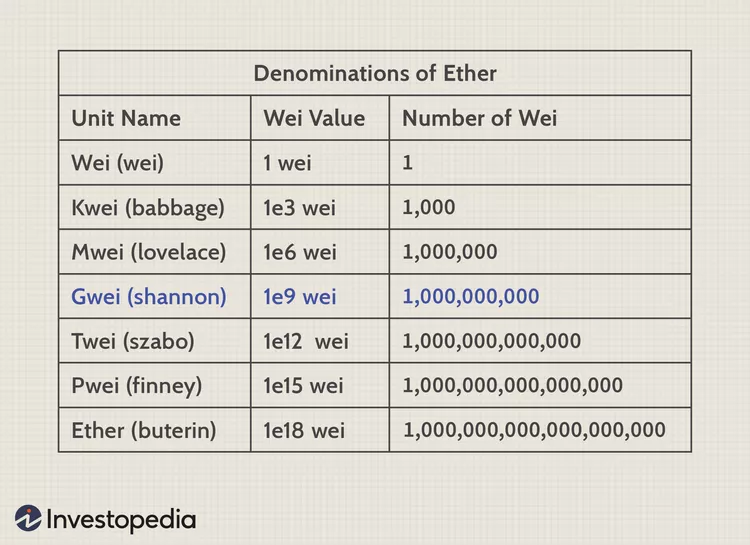
That is the smallest unit of Ethereum (1 ETH = 10¹⁸ Wei). It’s named after Wei Dai, a cryptographer finest recognized for “B-money”, a theoretical digital foreign money that launched key concepts later utilized in Bitcoin and Ethereum. Dai’s ideas of decentralized cash with out authorities management laid the groundwork for at this time’s cryptocurrencies.
Notably, no matter their magnitude, all upward items even have one other title that carries the “Wei” suffix, with completely different prefixes indicating their scale. This naming conference follows the metric system, the place prefixes like kilo-, mega-, and giga- assist outline multiples and subdivisions of a unit.
This unit is called after Charles Babbage, an English mathematician and inventor. He developed the primary automated computing engines within the 1800s, which laid the muse for contemporary computer systems. As a decentralized computing community, Ethereum honours him for his visionary concepts.
That is named after Ada Lovelace, who is commonly referred to as the world’s first programmer. She was the daughter of the poet Lord Byron and a superb mathematician. Lovelace wrote the first-ever algorithm for a computing machine, predicting that computer systems might do extra than simply crunch numbers, an concept that instantly ties into good contracts on Ethereum.
Named after Claude Shannon, the daddy of knowledge concept. His work in cryptography and digital communication types the spine of recent computing and blockchain encryption. Gwei being broadly used for gasoline charges on Ethereum makes his contribution much more related to customers at this time.
Named after Nick Szabo, the person who invented the idea of good contracts. Lengthy earlier than Ethereum existed, Szabo theorized digital contracts that might execute robotically, similar to at this time’s Ethereum good contracts. Many additionally consider he could possibly be Bitcoin’s mysterious creator, Satoshi Nakamoto.
Named after Hal Finney, one of many earliest Bitcoin builders. He was the primary particular person to obtain Bitcoin from Satoshi Nakamoto and performed a key position in refining blockchain expertise. By naming a unit after him, Ethereum acknowledges his groundbreaking contributions to cryptocurrency.
Lastly, the bottom unit of Ethereum, Ether (ETH), is called after Vitalik Buterin, Ethereum’s creator. He constructed Ethereum as a extra versatile and programmable blockchain, enabling good contracts, DeFi, and NFTs. Buterin’s work has remodeled the blockchain panorama past simply digital foreign money.
Why This Naming System Is Distinctive
Ethereum’s naming conference isn’t only for present; it displays the historical past of computing, cryptography, and digital cash. It reminds customers that Ethereum isn’t only a monetary device however a revolutionary computing platform constructed on the concepts of visionaries, mathematicians, and cryptographers.
So, subsequent time you see Gwei in gasoline charges or hear about Wei in good contracts, you’ll know that these aren’t simply random names; they’re a part of a deeper historical past that introduced Ethereum to life.
Gwei and ETH’s Position in Ethereum’s Future
Ethereum is consistently evolving, and because it scales to fulfill rising adoption, gasoline charges and Ether (ETH) and subsequently, Gwei’s position might change considerably.
Ethereum’s latest transition to Proof of Stake (PoS) with Ethereum 2.0 has already introduced noticeable enhancements. Enhanced scalability and diminished community congestion have led to extra steady gasoline costs and a smoother person expertise. Future upgrades, which Vitalik Buterin has hinted would concentrate on Layer 2 options, are anticipated to additional optimize transaction processing and probably drive gasoline charges even decrease.
Gwei offers a versatile system to maintain transaction prices manageable, however in a world of ultra-low charges, Ethereum-based providers would possibly begin quoting costs in even smaller items, shifting decimals the best way fiat currencies generally do throughout inflation or deflation.
There’s additionally the intriguing chance that future technological breakthroughs might cut back and even eradicate the necessity for gasoline charges altogether. Ought to that happen, the excellence between ETH and its subunits would possibly grow to be much less crucial.
Ethereum’s roadmap is filled with upgrades round safety, effectivity, and sustainability, and the way customers work together with transaction prices might basically change. So, the thought of Gwei changing into isn’t one thing we are able to 100% rule out.
Nevertheless, till such a paradigm shift is realized, Gwei stays a key a part of Ethereum’s usability. And so long as gasoline charges exist, Gwei (or one thing prefer it) will probably stick round.
Disclaimer: This text is meant solely for informational functions and shouldn’t be thought-about buying and selling or funding recommendation. Nothing herein ought to be construed as monetary, authorized, or tax recommendation. Buying and selling or investing in cryptocurrencies carries a substantial danger of monetary loss. All the time conduct due diligence.
If you want to learn extra articles like this, go to DeFi Planet and comply with us on Twitter, LinkedIn, Fb, Instagram, and CoinMarketCap Group.
Take management of your crypto portfolio with MARKETS PRO, DeFi Planet’s suite of analytics instruments.”